

How Do You Balance Durability, Cost, and Installation Speed in Ground-Mounted Solar Projects?
Jun 01 , 2026
Ground-mounted solar systems are widely used in utility-scale, commercial, and agricultural photovoltaic projects. When planning a ground-mounted installation, developers often face a common challenge: balancing durability, cost, and installation speed. Achieving the right combination of these three factors is essential for maximizing project value and long-term performance.
Durability is the foundation of any successful solar project. A ground-mounted system must withstand decades of exposure to wind, rain, UV radiation, and temperature fluctuations. High-quality materials such as hot-dip galvanized steel and anodized aluminum are commonly used because they offer excellent corrosion resistance and structural strength. While premium materials may increase initial investment, they often reduce maintenance costs and extend system lifespan.
Cost is another critical consideration. Project owners naturally seek solutions that deliver strong performance without exceeding budgets. The key is not simply choosing the cheapest option but selecting components that provide the best long-term return on investment. For example, a mounting system with optimized structural design can reduce material consumption while maintaining required load capacities. This helps lower procurement and transportation costs without compromising reliability.
Installation speed directly impacts project timelines and labor expenses. Faster installation means lower labor costs and quicker project completion, allowing the solar plant to begin generating electricity sooner. Modern ground-mounted systems are increasingly designed with pre-assembled components and simplified connections to reduce on-site work. Features such as modular structures and standardized hardware can significantly improve installation efficiency.
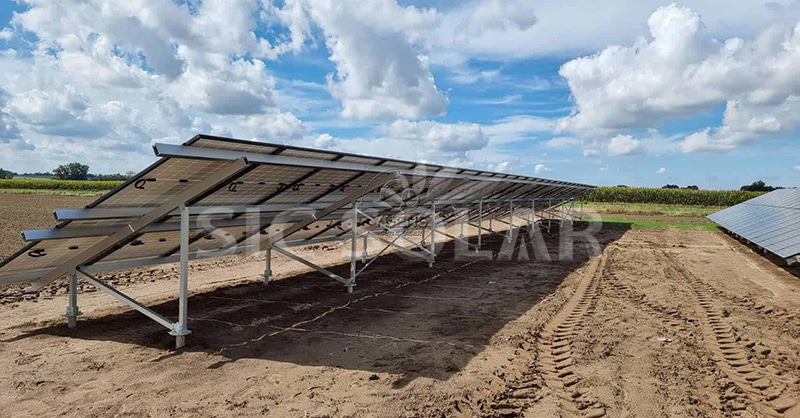
Foundation selection plays an important role in balancing these factors. Ground screws, driven piles, and concrete foundations each offer different advantages. Ground screws are often preferred for their rapid installation and minimal site disturbance, while driven piles can provide excellent efficiency for large-scale solar farms. Concrete foundations may offer additional stability in challenging soil conditions but typically require more labor and construction time.
Proper engineering is essential to avoid unnecessary costs. Over-designed systems can increase material expenses, while under-designed structures may compromise safety and durability. Detailed site assessments, including soil analysis and wind load calculations, help engineers optimize the mounting structure for specific project conditions.
Manufacturers such as SIC Solar focus on providing photovoltaic mounting solutions that balance strength, cost-effectiveness, and ease of installation. By offering adaptable ground-mount systems compatible with different foundation types, SIC Solar helps project developers achieve efficient construction while maintaining long-term structural reliability.
Another effective strategy is standardization. Using proven mounting designs and standardized components reduces engineering complexity, streamlines logistics, and simplifies installation. This approach can improve both project speed and cost control while ensuring consistent quality.
Successful ground-mounted solar projects require careful planning and the right combination of materials, foundation methods, and mounting technologies. By optimizing system design and selecting reliable mounting solutions, developers can achieve durable structures, controlled project costs, and efficient installation schedules that support long-term solar energy production.