
Wonach suchst du?

Plastic ballasted solar mounting systems offer a practical solution for installing solar panels on suitable flat roofs where roof penetrations should be minimized. Their lightweight components are easy to handle, and the flexible layout can accommodate different panel arrangements while helping protect the existing roof surface.
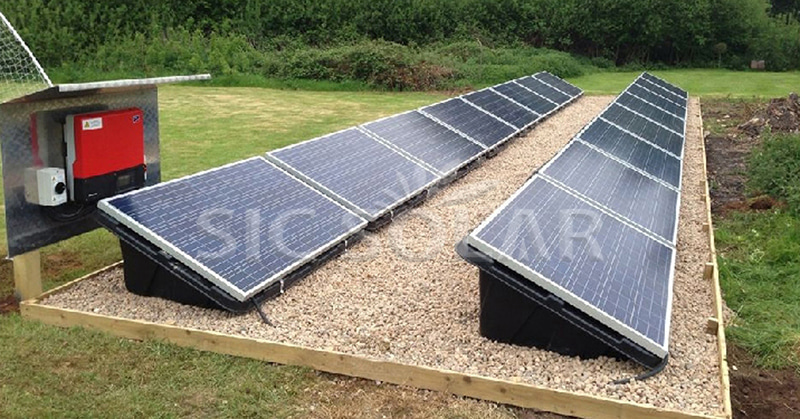
Plastic components are lightweight and easy to handle, making transportation and on-site assembly more convenient. Depending on the design, pre-assembled parts can also help reduce installation time and labor costs.
Ballasted systems use weights to help secure solar panels without relying entirely on roof penetrations. This can help protect the roof's waterproofing layer. However, the roof must support the additional weight, and ballast requirements should be calculated according to local wind conditions.
Unlike untreated metal, plastic does not rust. Outdoor-grade materials can withstand moisture and everyday weather exposure, but UV resistance, temperature tolerance, and long-term durability should be checked before choosing a system.
Plastic ballasted mounting systems can be arranged to suit different panel layouts and roof spaces. They are commonly used on commercial and industrial flat roofs, provided the roof's load capacity, drainage, and wind-load requirements are properly assessed.
SIC Solar manufactures and supplies photovoltaic mounting brackets for a range of solar applications. When selecting a plastic ballasted system, buyers should consider material quality, ballast requirements, panel compatibility, and site-specific loads.
Q1: Where can plastic ballasted solar mounting systems be used?
They are commonly used on suitable flat roofs and other approved surfaces where the system meets structural and installation requirements.
Q2: Do these systems require roof drilling?
Many designs minimize roof penetrations, but the fixing method depends on the roof structure, wind loads, and project requirements.
Q3: Can plastic ballasted systems withstand strong winds?
They can be designed for specified wind conditions when the ballast, layout, and fixing method are properly calculated.
Q4: What information is needed for an RFQ?
Provide the roof dimensions, panel specifications, project location, wind-load requirements, and estimated quantity.
Q5: Are plastic components UV-resistant?
UV resistance depends on the material formulation and protective additives. Check the product specifications for details.
Q6: Can the mounting system be customized?
Customization may be available for panel dimensions, roof layout, tilt angle, and other project requirements.
Q7: How can I get a quotation from SIC Solar?
Send your project details, roof drawings or photos, panel specifications, and required quantity so the team can assess your needs.



 IPv6 Netzwerk unterstützt
 Deutsch
  English
 español
 português
 Nederlands
 العربية
 日本語
日本語 한국의
한국의 Melayu
 Tiếng việt